For several years now, a current of young African leaders—figures of the pan-Africanist movement—has been stirring both strong support and sharp criticism. Accused by some observers and Western institutions of running “propaganda” campaigns on behalf of foreign powers like Russia, they nonetheless continue to embody, for a large segment of African youth, the symbol of a struggle for sovereignty and emancipation.
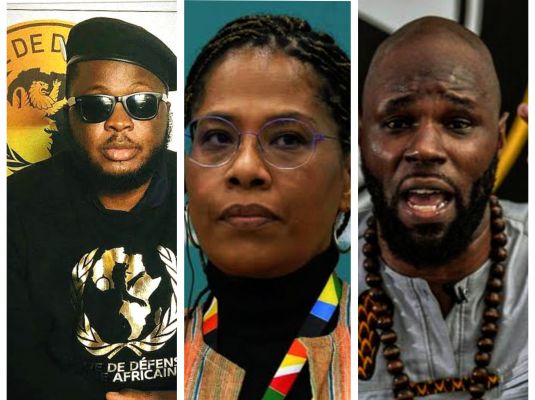
Among these figures, Nathalie Yamb, often nicknamed “the lady of Sochi,” is one of the personalities facing travel bans in Europe. Yet far from silenced, she reaffirmed her determination: “You can prevent me from flying over the territory of the European Union, but you will never prevent my words from reaching Europe.”
This statement reflects a conviction widely shared by pan-Africanist activists: the battle of ideas transcends physical borders and finds in social media an essential space for expression.
Another central figure, Kemi Seba, remains deeply polarizing. Frequently presented as a militant “close” to certain external influences, he nonetheless surprised many in 2023 at the Africa-Russia interparliamentary session in Moscow. Invited as a guest of honor alongside Nathalie Yamb, he issued a blunt warning:
“Africans will never again tolerate replacing one colonizer with another, whether Western, Russian, or Chinese.”
This speech, delivered before Russian officials and more than 40 African parliamentary delegations, underscored a firm determination to assert African independence vis-à-vis all foreign powers, not just the West.
Egountchi Behanzin, “commander-in-chief” of the Ligue de Défense Noire Africaine (LDNA), is also part of this movement.
Responding recently to an article labeling them “propagandists,” he denounced what he described as a disinformation campaign: “Another piece of propaganda trash published by a collaborationist media. They talk about us, they insult us, they stick labels on us, but we are never given the right to respond. Only one version is served, their version, built on lies.”
For him, such accusations are simply a continuation of an old strategy aimed at discrediting dissenting voices. Recalling the example of Bokassa, falsely accused of cannibalism in the 1970s, Behanzin insists: “Today, this old method of demonization no longer fools anyone. People are vigilant, they know how to recognize manipulation, and they will no longer be deceived.”
Close ties with military regimes gaining support of African youth
These young leaders also maintain open ties with the military juntas currently ruling Mali, Burkina Faso, and Niger. These regimes, which came to power through coups d’État by removing leaders accused of being too close to France, enjoy notable popular support. Yet their political choices also raise concerns: while the soldiers are celebrated as heroes, they have not yet opened a path toward civilian rule or a lasting democratic transition.

The enthusiasm they generate among African youth is rooted in widespread disillusionment. Many young people see in Yamb, Seba, or Behanzin courageous voices that articulate their frustrations with persistent inequality, economic dependency, and foreign influence. This massive support contrasts with warnings from Western governments and international NGOs, which regularly denounce their discourse as “manipulative” or “simplistic.”
The reality remains complex. On the one hand, these militant voices carry demands for sovereignty and dignity—powerful themes that resonate with a generation seeking alternatives. On the other hand, their political alignments and the delays in presenting concrete proposals for democratic transitions raise questions. Most justify their stance by arguing that it is not yet the right time to impose democracy in countries plagued by insecurity, claiming that a rushed process would only restore leaders seen as beholden to foreign interests.
Are they right? Time will tell. Beyond the accusations of propaganda, their influence illustrates how a new African generation intends to assert itself on the global stage—even at the cost of blurring traditional boundaries between civic engagement, political activism, and geopolitics.